The Institute of Environmental Health and Sustainable Development (IEHSD) was established in 2013 under the Vietnam Union of Science and Technology Associations (VUSTA). Through its operation and development, IEHSD has gathered a network of leading experts from specialized research institutes and universities in the fields of public health and agriculture, across Vietnam.
The fields of science and technology of the Institute were approved by the Ministry of Science and Technology (MOST) and the Ministry of Public Security (MPS) on April 26, 2013. IEHSD has been focusing on research, training and delivery of services in environmental health and sustainability programming through inter-sectoral coordination and interdisciplinary actions towards human health.
The Institute of Environmental Health and Sustainable Development (IEHSD) is a science and technology organization. IEHSD was officially established and put into operation under Decision No. 227/QD-LHHVN, dated April 9, 2013 of the Presidium of the Central Council of the Vietnam Union of Science and Technology Associations. The fields of science and technology of the Institute were approved by the Ministry of Science and Technology (MOST) and the Ministry of Public Security (MPS) on April 26, 2013. IEHSD has been focusing on research, training and delivery of services in environmental health and sustainability programming through inter-sectoral coordination and interdisciplinary actions towards human health. IEHSD has collaborated with the Central Institute of Hygiene and Epidemiology (NIHE), the Center for Public Health and Ecosystem Research (CENPHER), and the Institute of Veterinary Medicine (NIVR), the International Institute for Livestock Research (ILRI). , Vietnam National Academy of Agriculture (VNUA) and Vietnam One Health Network of Universities (VOHUN) to conduct interdisciplinary research on health risk assessment related to agricultural intensification, livestock production farming, clean water, environmental sanitation and community development. IEHSD has amassed an impressive track record and established a strong reputation in food safety hazard analysis; research on the knowledge, attitudes and practices of farmers and public health workers; and public health intervention programs.
Vision
Our vision is to be a leading research and development institute in the field of environmental health and sustainable development to improve human, animal and plant health towards sustainable development.
Mission
Our mission is to collaborate and empower leading scientific experts to identify local solutions to the areas of environmental health research, training and service delivery, and sustainable development programs that are scalable across the country, then introduce these solutions to global forums.
Functions, Duties
The main areas of research are focusing on the areas of health and development, with particular emphasis on the environment and agriculture.
1. Scientific research and technology application covers the fields of medicine, human health protection, environmental improvement, waste treatment, hazardous substances, biodiversity protection, adaptation to climate change, ecosystem change, food security, energy poverty reduction and sustainable development.
2. Science and technology services: consulting, social criticism, communication and project implementation, program development, dissemination of policies and laws and higher education qualifications in the field of environmental health environment, labour, transport, agriculture, global health and sustainable development.
3. Cooperate with other organizations and individuals at national and global levels to carry out the Institute’s mission.
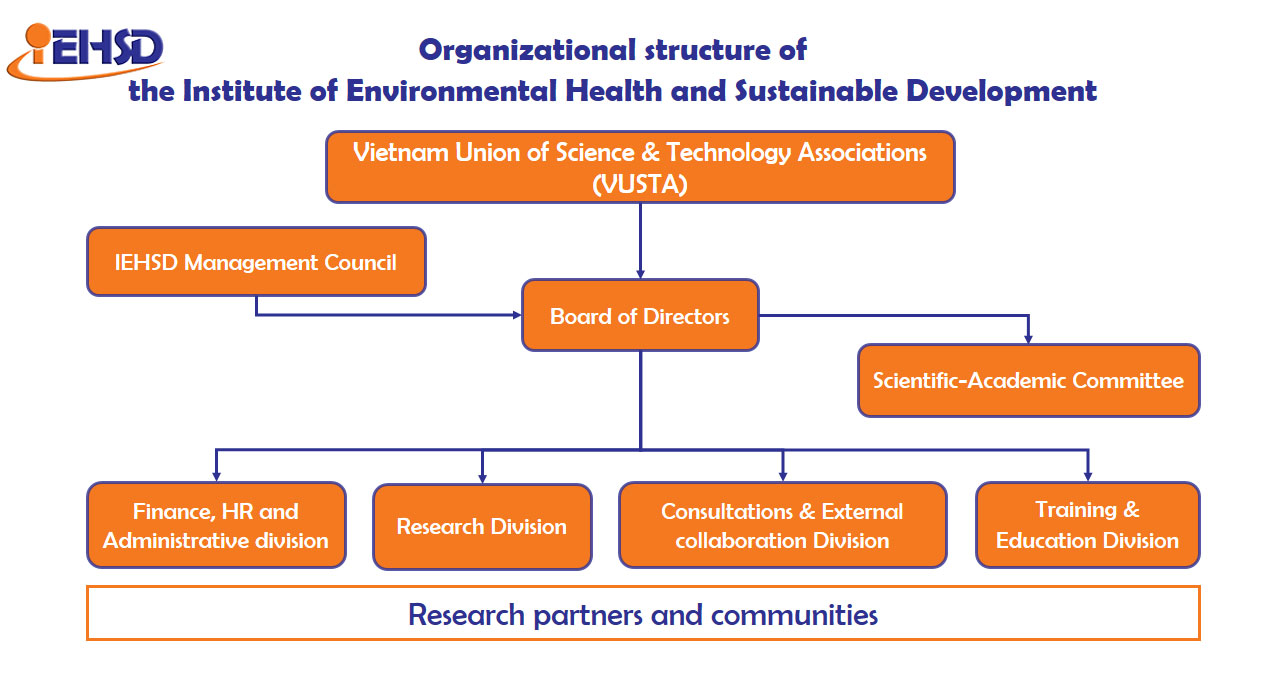
Organizational structure
Gender equality policy
SECTION I – PURPOSE AND APPLICATION
This policy provides the requirements which IEHSD staff, managers and leadership members are required to implement to achieve the purpose of the gender equality in the Institute.
This policy applies to the staff and leadership of the Institute of Environmental Health and Sustainable Development.
IEHSD promotes an organizational culture which highly values equity, female and male staff have equal value and are accorded equal treatment.
To achieve these objectives, the institute is committed to improving and promoting gender equality and diversity in recruitment, workplace, payment, promotion, and capacity building.
SECTION II – DEFINITIONS
- Gender* refers to the social, behavioral, and cultural attributes, expectations, and norms associated with being female, male, intersex, transgender, or gender diverse;
- Gender Equality in the workplace* means ensuring all employees are able to access and enjoy the same rewards, resources and opportunities regardless of their gender.
- Gender Equity* means fair treatment for all according to their respective needs. It may include equal treatment or treatment that is different but which is considered equivalent in terms of rights, benefits, obligations and opportunities;
SECTION III – PROCESSES
Recruitment
- The Institute undertakes recruitment in accordance with the recruitment policy and job requirements to provide equal employment opportunities in staff appointment and career development;
- The Institute must establish principles that can increase transparency and help avoid unconscious biases during staff recruitment;
- The Institute leadership will ensure position descriptions, selection criteria and advertisements are expressed in gender-neutral terms, unless a minority or disadvantaged group is to be targeted.
Workplace
- Managers and staff members use generic language carefully in the workplace to avoid bias in favor gender and discrimination against another. The requirements include using generic language which can apply equally to all genders, avoiding offensive and patronizing terms, avoiding assumptions about people based on stereotyping or gender roles, avoiding offensive jokes about women, men, intersex, transgender, and gender diverse people, and using pronouns and titles appropriately.
Payments
- The Institute will ensure equal pay for equal work done by women and men, which means there is no distinction between men and women in payment. The salary paid to employees depends only on the job position and the number of years of experience. (Equal work involves similar tasks which require similar knowledge and skills).
Promotions
- The Institute ensures equal participation of women and men in senior positions.
- Provide fair procedures for staff recruitment as well as a performance assessment scheme that is not flawed by gender biases.
- The Institute will ensure women and men will have an equal chance at promotion in their institute.
Gender capacity building of the Institute
- The Institute provides training opportunities to staff members to participate in short course on gender at least very two years.
- The Institute leadership ensure new staff to participate in training on gender, gender equality.
- The Institute encourages and supports staff in engaging in best practice and information sharing around gender mainstreaming initiatives.
The Institute conducts a anonymous staff survey every 3 year to obtain feedback on gender equality, gender diversity and gender discrimination. Based on identified issues, the Institute will prepare action plan to address the feedback from staff gender survey.